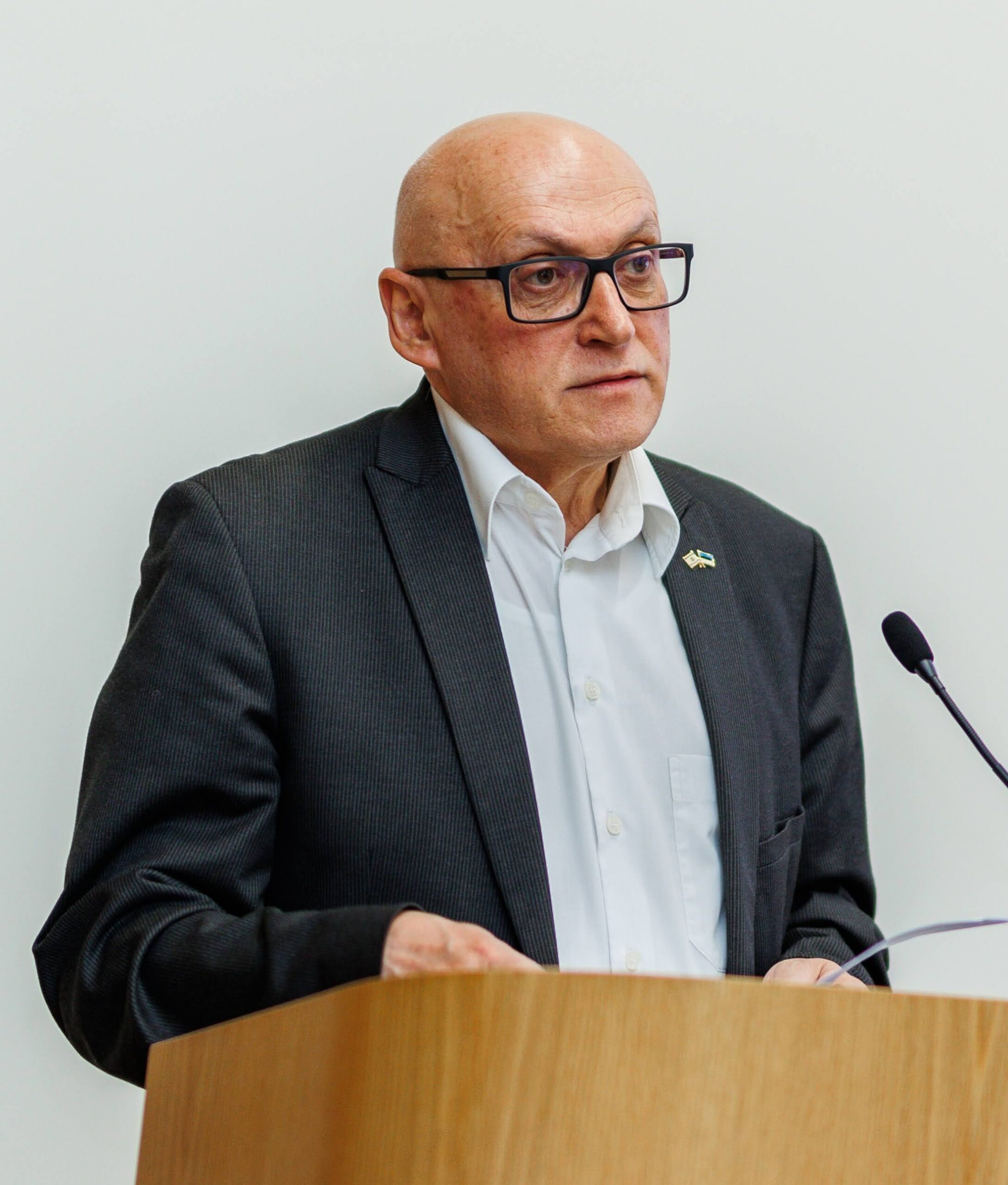
 Gennadi Gramberg, Director of the Estonian Jewish Museum,
 Rico Pall,
 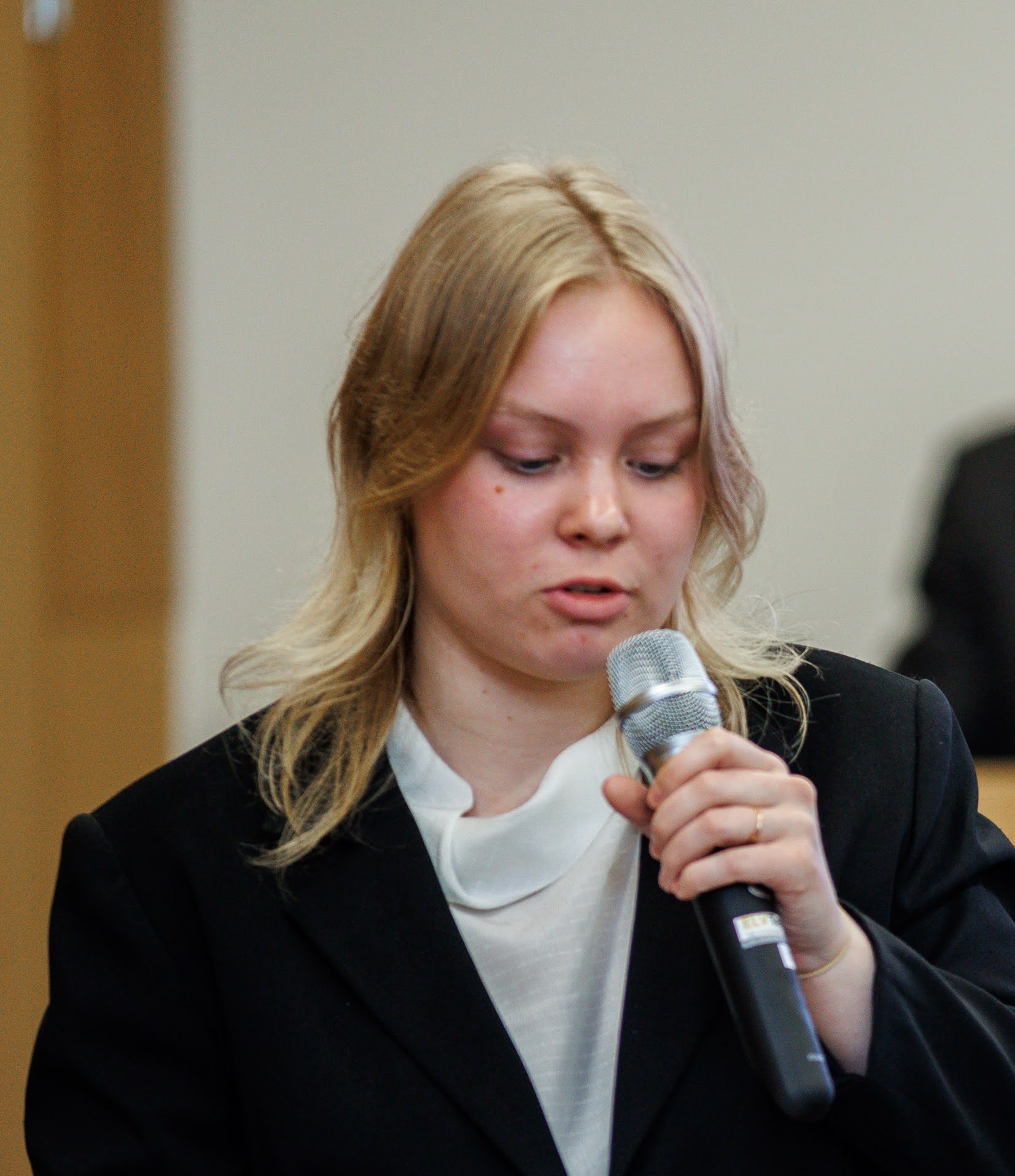 Polina Smagina, students from the 11th grade of the Tallinn Jewish School
In my presentation, I try to create a comprehensive picture of the main events that took place within the Estonian Jewish community that led to the adoption of cultural autonomy. As sources, I use archival documents and the press. These materials formed the basis for the exhibition, which will be officially opened during the intermission.
Slide 2
The ideas of cultural autonomy resonated among the fathers of Estonian independence. We see this in the text of the Manifesto addressed to all the peoples of Estonia — the first official document formulating the ideas of Estonian statehood. Although Estonia was not as multi-ethnic a state as Austria-Hungary, a large German minority lived here, who had possessed class privileges and power over the centuries. Russians had until recently held the status of the ruling nation, which stemmed from the Tsarist government's policy of Russifying the peripheries.
For Jews, however, a turning point arrived: until recently, they were part of Russian Jewry, experiencing discrimination and humiliation, but with Estonia's independence, their situation changed drastically as they had to define themselves as Estonian Jews.
The young Republic of Estonia defined itself as a democratic state and was interested in the loyalty of ethnic groups. The promise of cultural autonomy was to become a kind of roadmap for creating a modus vivendi (way of coexistence) between Estonian society and national minorities. Point 2 of the Manifesto formalized this promise.
Rico Pall
Manifesto to All the Peoples of Estonia. Estonia, within her historical and ethnographic borders, is declared from this day forward an independent democratic republic.
Polina Smagina
Until the Estonian Constituent Assembly, convening on the basis of universal, direct, secret, and proportional voting, definitively determines the order of governance of the country, all governing and legislative power remains in the hands of the Estonian Maapäev (Provisional Parliament) and the Estonian Provisional Government created by it, which must act in accordance with the following guiding principles in its activities:
Rico Pall
Point 2: National minorities living within the borders of the Republic — Russians, Germans, Swedes, Jews, and others — are guaranteed their rights to national-cultural autonomy.
Slide 3
Achieving independence changed the situation of Jews very profoundly. Restrictions and discriminatory laws placed upon Jews lost their validity. Having previously been part of the seven million-strong Russian Jewry, Estonian Jews now had to define themselves as Estonian Jews. The prerequisites for this were created by the democratic character of the young Republic of Estonia.
To coordinate the activities of Estonian Jewish communities, an attempt was made as early as December 1918 to convene an all-Estonian congress of Jewish communities in Tartu, but the outbreak of combat operations in the War of Independence made it impossible for all delegates to arrive. It was not until May 1919 that the First Congress of Estonian Jews was convened in Tallinn, which announced full support for a free Estonia and the loyalty of Jews to the state. The National Archives of Estonia preserve a file with the congress materials. One of these documents is an appeal to the government adopted at the congress.
Polina Smagina
The wording of this document is in the orthography of that time.
To the Chairman of the Council of Ministers of the Republic of Estonia.
The Congress of Representatives of the Jewish Community Councils, whose objective is the implementation of regulations, care for the congregation, and the development of the civic, political, and national rights of Jews living in Estonia, recognizes how much it owes to the free Republic of Estonia for the conditions of free political activity granted to it. The Congress asks you, Mr. Chairman of the Council of Ministers, to accept its assurances of the complete loyalty of the Jews living in the free Republic of Estonia and their heartfelt desire to complement and develop their free institutions. Long live Free Estonia!
Tallinn Jews collected 160,000 marks for the government's relief fund, which was a very significant sum for that time.
Despite this, antisemitism gaining a foothold in Estonia and prejudicial attitudes towards Jews sometimes manifested completely unexpectedly. For instance, in local government elections, Jews were sometimes forgotten to be entered into the voter registries. In Tartu, the local political committee of the Jewish community protested so energetically that the voter lists were eventually supplemented.
When the debate on the republic's first constitution began in the Constituent Assembly, Jews expected that the promise given in the Manifesto would also be reflected in the constitution. As shown by the correspondence of the National Committee of Estonian Jews, elected at the First Congress of Communities, with the Constitutional Committee of the Constituent Assembly and the leaders of the German minority, efforts were made to fix the spirit of the Manifesto addressed to all the peoples of Estonia in the document. In particular, the committee sought recognition for Jews as a traditional national minority alongside Germans, Russians, and Swedes.
On December 22, 1919, the Estonian Jewish National Committee sent an appeal to the Constitutional Committee of the Constituent Assembly, drawing attention to the omission of the Jewish national minority in the text of the draft Constitution alongside Germans, Swedes, and Russians. In the opinion of the National Committee, Jews also belong to the so-called traditional national minorities.
In the Estonian Constitution adopted by the Constituent Assembly on June 15, 1920, national minorities are not mentioned by name at all. Therefore, Article 21 does not mention minorities at all, and the concept of cultural autonomy is very vague.
§ 21. Members of national minorities living within the borders of Estonia may establish autonomous institutions in the interest of their national culture and welfare, insofar as they do not run counter to state interests.
Slide 4
After the suppression of the communist coup attempt of December 1, 1924, leaders of the German minority met with state leaders and drew their attention to the fact that the promise of cultural autonomy had not yet been implemented, even though national minorities remained loyal to Estonia during the mutiny. The development of the Cultural Autonomy Act began. A rather emotional correspondence with the leaders of the German minority is preserved in the National Archives.
The Baltic Germans had their own representatives in the Riigikogu — the German-Baltic Party — but the Jews lacked representation, which is why the National Committee, led by Hirsch Eisenstadt, tried to push its proposals through via the Germans. Dr. Max Klompus acted as a kind of liaison officer between the Jewish National Committee and the Baltic German Chief Committee.
The debate on the law in the Riigikogu was very turbulent. The greatest fear was that cultural autonomy could become a state within a state. As a result, the main areas of activity for autonomy in the law remained education and culture, and the governing body of autonomy — the Cultural Council — was essentially a subordinate institution of the Ministry of the Interior. On February 12, 1925, the law was passed. The Germans were the first to adopt autonomy. On November 1 of the same year, the inauguration ceremony of the elected Cultural Council took place at the House of the Blackheads. From the Jewish community, National Committee member Dr. Max Klompus received an invitation.
Slide 5
The example of the Germans was inspiring, but in the enthusiasm following the passage of
the law, not all of its nuances were fully investigated. A hastily prepared application was rejected. The Tallinn newspaper "Kaja" reported this on September 10, 1925, in an article titled "Lithuanian Jews Desire Cultural Autonomy." The newspaper writes:
The first application to form a cultural self-government was submitted at the end of August, but the government rejected it because Lithuanian citizens and stateless persons were among the applicants.
According to the Cultural Autonomy Act, this right belonged only to Estonian citizens.
The law passed by the Riigikogu allowed national minorities to organize their cultural affairs on a self-governing basis. Until then, only the Germans had exercised this right.
At a recent meeting held in Tallinn, representatives of Jewish congregations decided to demand cultural autonomy for the Jewish national minority.
The article suggests that the Jews are likely to submit a new lawful application in the near future. However, this did not happen until March 1926.
Slide 6
According to the law, a national minority could apply for cultural self-government if there were at least 3,000 Estonian citizens. The Jewish National Council called on Jews to apply for citizenship, providing applicants with all kinds of assistance, including language training. The leadership of the Tartu Jewish community was particularly active in this regard. An example from the archives:
The citizenship file of Zivja (Zilja) Goldberg. She was born in 1873 in Põltsamaa, lived in Tartu, was a seamstress and a widow. Since her husband was originally from Latvia, Zivja became a Latvian citizen after Estonia's independence. She submitted her application to obtain Estonian citizenship on November 20, 1919, but only became a citizen together with her younger son in 1923.
In October 1925, 3,045 citizens of Jewish descent lived in Estonia.
Slide 7
To popularize the idea of cultural autonomy, lectures and discussions were organized, mainly in Tallinn and Tartu.
For this purpose, prominent Jewish figures were invited to Estonia. The Tallinn newspaper "Päevaleht" wrote on November 24, 1924, that among them was one of the leaders of the Zionist movement and an advocate of Jewish autonomy, the journalist and orator Vladimir (Ze'ev) Jabotinsky. He delivered a lecture titled "Jews and Militarism" at the Estonia Concert Hall.
Jabotinsky visited Estonia several times. Under his influence, the Zionist organization "Beitar" was established in Estonia, which became one of the most influential Jewish associations in Estonia.
The Zionist association carried out very active information work to promote cultural autonomy. For example, on March 3, 1925, an advertisement by the local Zionist organization appeared in Päevaleht stating that on March 4, Moshe de-Shalit, a representative of the Jewish National Fund, would give a lecture titled "Ghetto, National Autonomy and National Home" in the hall of the Tallinn Jewish Gymnasium.
Slide 8
On March 30, 1926, the government approved the regulations for the elections of the Jewish Cultural Council of the Republic of Estonia.
8 electoral districts and election committees were formed. The election days were May 23–25, 1926. Elections for the Cultural Council were to take place every three years.
An archival document shows that Julius Gens, who would later become a well-known art collector, was appointed as a member of the election committee for the 1st station of the 5th electoral district of Tartu during the elections of the first Cultural Council.
Slide 9
The Cultural Council elections were set for May 23–25. The election campaign began, and its intensity grew as election day approached. The electoral lists organized meetings, and leaflets and campaign materials were published. The Zionists showed particularly high activity, both left-wing, such as Poalei Zion, and right-wing.
Materials were published in Yiddish, which was the spoken language of the Jews at the time. In Tallinn, materials were printed at the Beilinson printing house located on Tartu Road. Voting ballots were prepared for the elections, where some lists were merged.
Slide 10
The electoral list included 2,041 citizens. 42 candidates ran in the elections. During the election days, 1,464 voters, or 71%, cast their ballots. 27 people were elected.
This list includes a whole series of people who played an important role in the activities of the Jewish Cultural Autonomy. Here is the lawyer Markovitš, Leiser Kropman from Tartu. Banker Hirsch Aisenschtadt, whose house currently hosts the Turkish Embassy. Šmarja Tamarkin was a teacher and a leading figure in Jewish education in Estonia.
Here is also Elias Uzvanski, on the site of whose shoe factory in Tartu the AHHAA Centre is currently located, where a wall of the factory building remains. And the first woman in the composition of the Cultural Council, Roza Klompus, née Zundelevitš, whose relative is present with us in this hall today.
Slide 11
The first meeting of the 1st composition of the Cultural Council of the Jewish Cultural Autonomy took place on Sunday, June 6, 1926, in the hall of the Tallinn Jewish Gymnasium. Invitations to this event were distributed in three languages — Estonian, Yiddish, and Hebrew — and were signed by the chairman of the main committee, Dr. Movša (Max) Klompus. This marked the beginning of the history of the cultural autonomy of the Jewish national minority of the Republic of Estonia.
Slide 12
The festive inauguration of the Cultural Council did not go unnoticed by the local press. Most of Estonia's leading newspapers published a fairly detailed description of the event. Only "Postimees" confined itself to a short news snippet. Thanks to these publications, we can reconstruct how this historic event unfolded.
The hall was packed to capacity. Directly in front of the stage are the members of the Cultural Council, and on the right side, the representative of the government and departments. Foreign Minister Piip, Assistant Minister of Education Mikkelsaar, Director General of the Ministry of the Interior Madisson, Adjutant to the State Elder Captain Tiiger, and representatives of the German and Russian national minorities have appeared.
In the balcony is the synagogue and school choir under the direction of Chief Cantor Jossel Gurewitsch. By the way, he was Eri Klas's grandfather. The male members of the choir wear black national skullcaps.
First, the choir performs Psalm 100 "Mizmor letoda" — the Psalm of Thanksgiving. The meeting is opened by Dr. Klompus, who expresses gratitude to the Estonian government for granting cultural autonomy to the Jewish population. He expresses special thanks to Director General Madisson of the Ministry of the Interior, upon whose shoulders fell the main work of organizing cultural autonomy on behalf of the government.
Foreign Minister Ants Piip spoke on behalf of the government.
Rico Pall From the speech of Foreign Minister Ants Piip at the opening meeting: This is an important moment on the thorny path of your ancient race. Perhaps the cultural council being opened today will remain the only phenomenon of its kind for a long time, but it shows that national intolerance is foreign to Estonia. Our manifesto of freedom was addressed to all the peoples of Estonia. Jews can continue their educational work, and the Estonian people will do everything to help them. Long live the republic, long live the national council!
The Foreign Minister's speech is followed by a tumultuous round of applause.
Polina Smagina Dr. Klompus, replying to the minister, says in fluent Estonian: "On behalf of all those elected to the first Jewish Cultural Council, on behalf of all Estonian citizens of Jewish descent, accept my deepest gratitude for the kind words with which you saw fit to welcome us. The Estonian people, who only recently cast off the yoke of slavery and began to establish their independent existence on state foundations, in accordance with their historical traditions, must understand how dearly one must value the preservation of a people's uniqueness and the development of national culture. From the bottom of our hearts, we wish flourishing, prosperity, and success to the Republic of Estonia, to Estonian democracy, for the happiness of the entire Estonian people and national minorities. Long live the Republic of Estonia! Long live the Government of the Republic of Estonia!"
This was followed by the state anthem performed by the choir and everyone present. This was probably the first instance where such a large gathering of representatives of the Jewish nation sang the Estonian anthem. "It sounded even purer than we ourselves know how to sing it," wrote "Päevaleht".
The Assistant Minister of Education, Mr. Mikkelsaar, says: "Your cultural wealth is our cultural wealth. We look forward to valuable cooperation in the field of Estonian education. Good luck."
On behalf of the German minority, the chairman of the board, Dr. Koch, presents greetings. He reassures that the representatives of the German minority are ready to continue supporting the Jews in organizing the activities of the autonomy in the future. Dr. Klompus expresses heartfelt gratitude for the assistance that the leadership of the German minority provided to the Jews on their path to cultural autonomy.
The meeting was also greeted by lawyer Gorškov on behalf of the Russian population and Pomerants on behalf of Zionist organizations. The latter announces that an application has been submitted to enter the Republic of Estonia into the Golden Book of the Jewish National Fund. Further speakers included Rabbi Mostovski of Tartu, school director Gurin, Tallinn City Council delegate Gutkin, representative of Estonian Jewish cultural organizations Halbreich, and representative of student organizations Sorkin.
A series of telegrams has arrived, which Dr. Klompus reads out; among others, greetings are sent by Minister of the Interior Einbund, Chairman of the Riigikogu Rei, and Tallinn Mayor Uuesson, in addition to a series of Jewish organizations and individual figures from home and abroad.
As "Päevaleht" writes, at the end Dr. Klompus thanks all those present, and then the old and mournful Zionist anthem Hatikva (meaning Hope) is sung, which feels like the cheerless wandering of the Jews in the desert.
Slide 13
On April 1, 1927, a delegation of Estonian Zionist Organizations and the representative of the Jewish National Fund (Keren Kayemeth Leisrael) Dr. Terlo from British Mandate Palestine met with State Elder Jaan Teemant and presented him with a certificate confirming the entry of the Republic of Estonia into the fund's Golden Book. You can see the original on the stage. The text is in Estonian and Hebrew.
The Republic of Estonia In token of deep gratitude for its historic act — which is the first in the history of the Jewish people — of granting national-cultural autonomy to the Jewish minority population in Estonia.
This event has been described by the newspaper "Maa". The article noted that the names of prominent figures such as Lord Balfour, whose declaration regarding the establishment of a national home for the Jews in Palestine can be considered one of the most important steps towards the creation of the State of Israel, are inscribed in this book. Estonia became the first country to be entered into the Golden Book.
And we are rightfully proud of it.
Translated by AI Gemini