 Anu Põldsam, Lecturer of Jewish Studies at the University of Tartu
"I grew up among Estonians in the countryside, in the village of Kõue, in the southeastern part of what is now the Harju District, where our family lived. My father was a tinsmith there. I clearly remember my first day of school at the Kõue Ministry School. This was in the early years of this century. The teacher brought me into the classroom, lifted me onto the table (I was small of stature), and showed me off like some kind of wondrous beast: 'Children, look, this is a Jew!'" – this is how Ester Žitomirski (1897–1985) recalled her childhood.
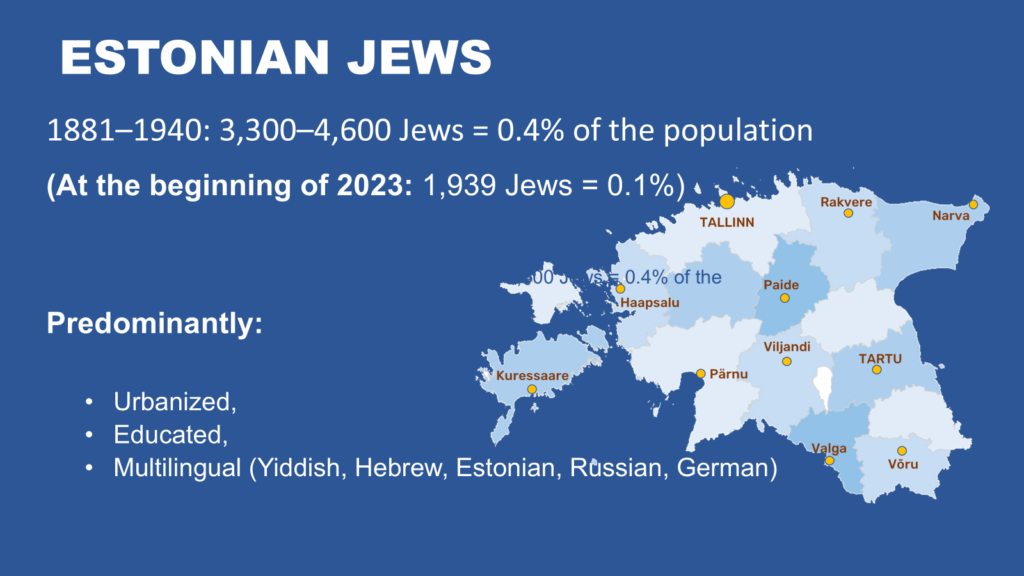
Who Were the Estonian Jews? While in the early years of the 20th century Estonians still knew very little about Jews (especially in rural areas), by the 1920s and 1930s the situation was different. Even then, Jews made up only 0.4% of the Estonian population, but in the context of independent Estonia and Jewish cultural autonomy, they had become an active, vibrant community well-adapted to Estonian culture, characterized by urbanization, high levels of education, and multilingualism. Yiddish was often spoken at home, prayers were held in Hebrew, education was acquired in Russian or German, and Estonian was used in professional life and interaction with the locals.
In general terms, one could say that the Estonian Jewish community simultaneously represented traits characteristic of both Western and Eastern European Jewry: here, in a manner characteristic of Eastern Jewry, they held fast to their Jewish identity and spoke Yiddish, but at the same time, in a manner characteristic of Western Jewry, they were modernized, largely secular, and acculturated. However, acculturation did not mean abandoning their own culture. On the contrary, already existing cultural activities became even more vibrant and diverse during the period of cultural autonomy.
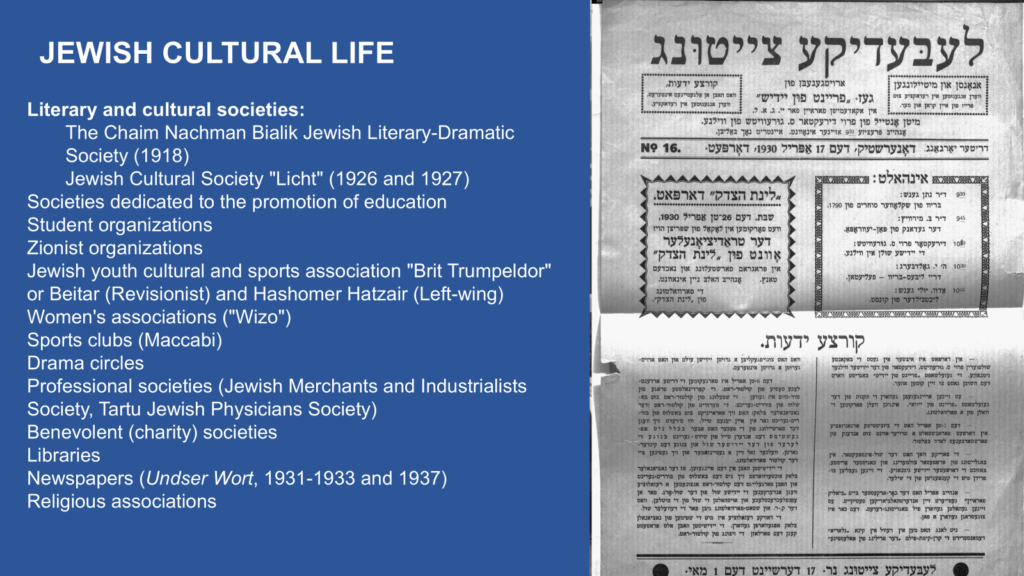
Despite the small size of the community, the cultural life of Estonian Jews was exceptionally active. During Estonia's first period of independence, more than 40 different Jewish societies, associations, and organizations operated here.
These included literary and cultural societies, of which perhaps the best-known and most active was the Chaim Nachman Bialik Jewish Literary-Dramatic Society—or simply the Bialik Society—which had become the center of cultural life in Tallinn. It organized literary evenings, lectures, concerts, theatrical performances, and so-called "living newspaper" evenings. The latter were highly popular mixed-format cultural evenings at the time, featuring readings of publicist journalism, short presentations, feuilletons, and musical pieces. For instance, in 1930, the Bialik Society hosted 14 "Living Newspaper" evenings, during which a total of 64 articles were presented by 28 different speakers. Similar living newspaper evenings were organized in Tartu by, for example, the Tartu Jewish Cultural Society "Fraint von Jidish". The society "Licht", which united Jewish workers, craftsmen, and working intellectuals, was also active in Tallinn and Tartu. In addition, there were societies dedicated to promoting education (the Hebrew Parents' Association "Achtus"), student organizations; Zionist organizations (along with youth and women's movements), which made up a third of the Jewish organizations here—with prominent spokespeople of the Zionist movement like Jabotinsky and Ben-Gurion visiting Estonia; sports clubs (Maccabi, which operated in five Estonian cities, tennis, bridge), drama groups, professional societies (the Society of Jewish Merchants and Industrialists, the Tartu Society of Jewish Doctors), and charitable societies. Furthermore, schools, libraries, and religious congregations were active, and Russian- and Yiddish-language newspapers were periodically published.
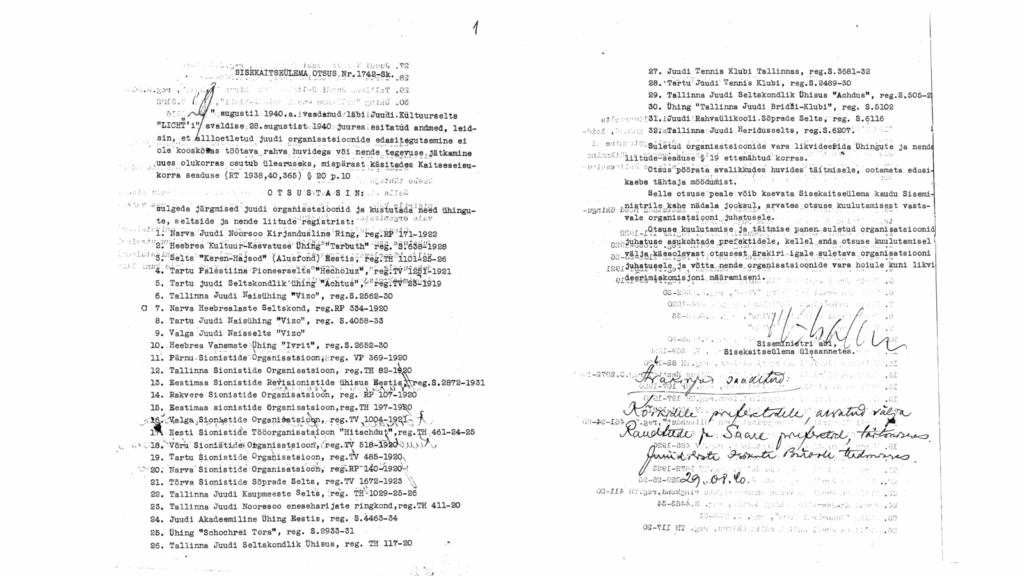
An eloquent list of the Jewish societies operating in Estonia just before the liquidation of cultural autonomy can be found in their closure decree in 1940. It is even more telling that the proposal for their closure was made by the cultural society "Licht", whose members were elected to the final Jewish Cultural Council in 1940. This council convened only once, and precisely for the purpose of proposing the liquidation of Jewish cultural autonomy. But let us not get ahead of ourselves.
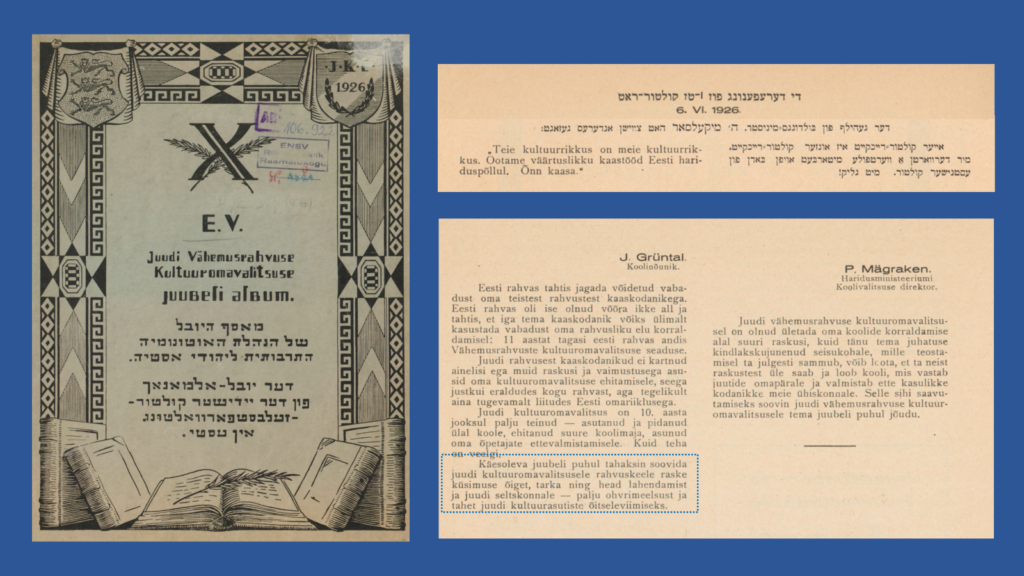
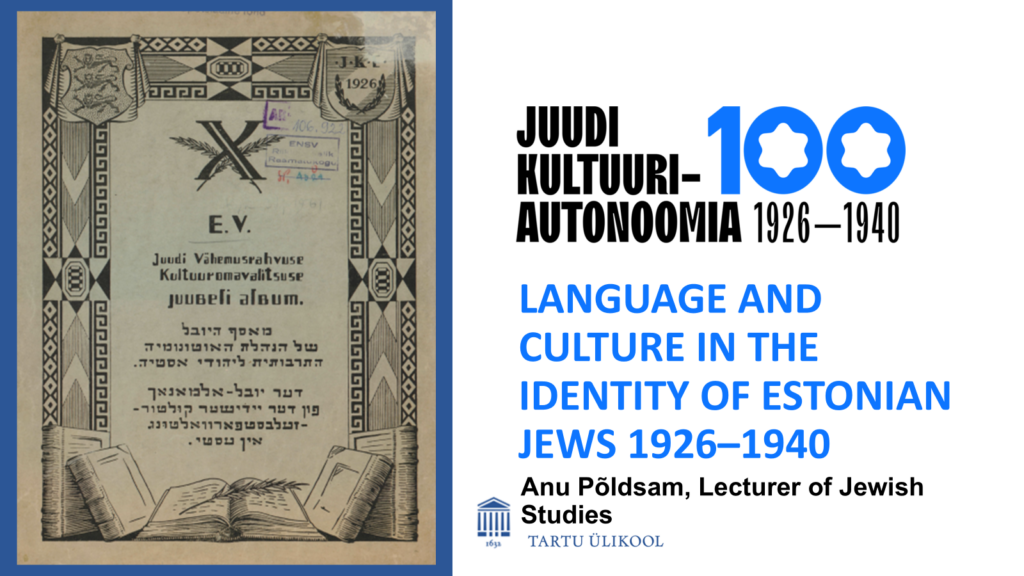
In the jubilee album for the 10th anniversary of Jewish cultural autonomy, one can find two eloquent quotes from Estonian statesmen. H. Mikelsaar, Assistant Minister of Education, said in 1926: "Your cultural wealth is our cultural wealth." And school inspector J. Grüntal noted 10 years later that much had been done, but there was still more to do, highlighting the resolution of the national language question.
And it is precisely about these two—culture and language—that I would like to speak a little today. That is, on one hand, how language served as a cultural bridge between the Estonian and Jewish communities, and at the same time, as a bone of contention within the Jewish community itself.
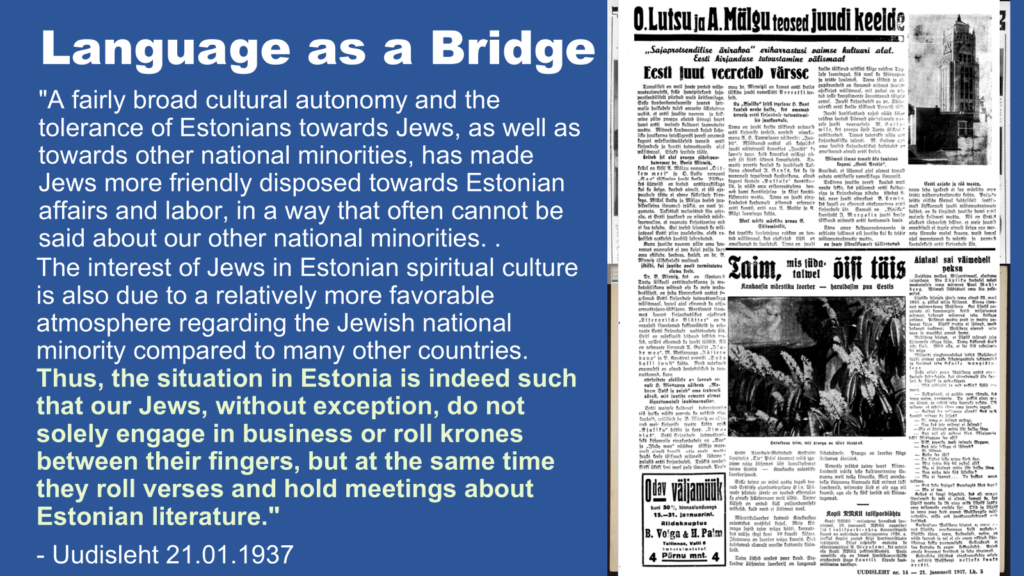
In 1937, the newspaper Uudisleht wrote: "The quite broad cultural autonomy and the tolerance of Estonians toward both Jews and other minority nationalities have made Jews more favorably disposed toward Estonian affairs and work, in a way that often cannot be noted regarding our other minority nationalities." This attitude is also well illustrated by a prayer composed by Josef Gurevitš for the 20th anniversary of the Republic of Estonia. But it is even better illustrated by the Jews' lively interest in the Estonian language and written word. Thus, the same paper continued with the observation that "Estonian Jews do not only engage in business or 'roll krones between their fingers,' but they also 'roll verses and hold meetings about Estonian literature.'"
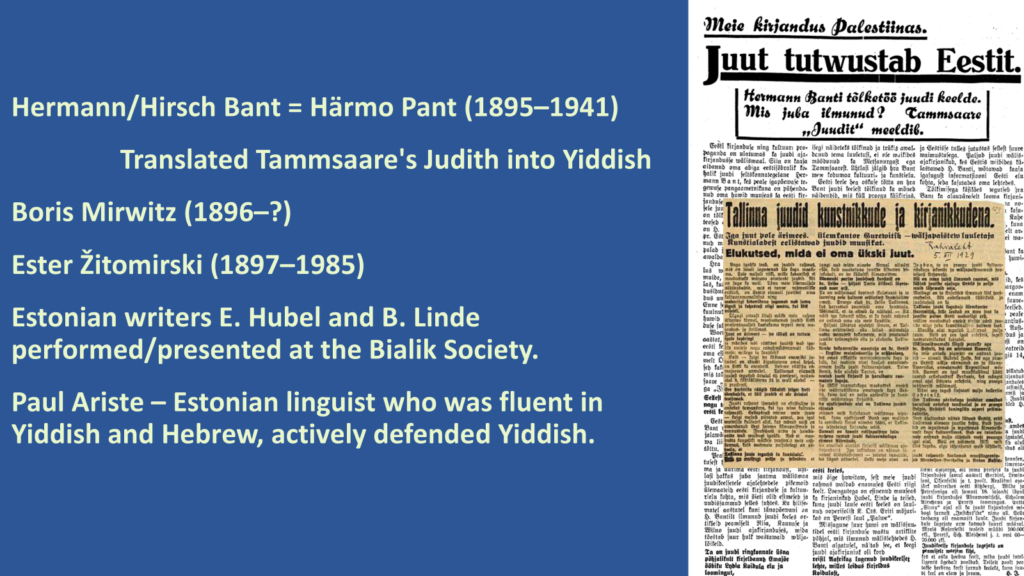
For Estonian Jews, language was not only a question of identity, but also a cultural bridge between different communities. One of the most remarkable examples of such a bridge-builder was Hermann Bant. Born in Lithuania, Bant came to Estonia at the age of 14, quickly mastered the Estonian language, married an Estonian woman, volunteered in the War of Independence, and later worked as a bank clerk. He dedicated his free time to introducing Estonian literature to Jewish readers. He wrote reviews of Estonian literature for Jewish publications in Riga, Vilnius, Kaunas, and Warsaw, and translated Tammsaare's Judith into Yiddish, which someone even attempted to get staged at a Jewish theater in New York. His articles published in 1927 in the Riga newspaper Frimorgen were the first comprehensive overviews of Estonian literature for the Jewish reader.
In addition, Dr. Boris Mirwits gave lectures on Estonian literature and translated their works (e.g., A. Mälk’s novel The Flowering Sea and O. Luts’s The Swamp; lectures were also published on A. Gailit's Fatherland, M. Metsanurk's Traceless Grave, and E. Krusten's short story A Hundred Gray Hairs).
Ester Žitomirski, mentioned at the beginning of the presentation, was also active as a cultural mediator, translating Jewish authors into Estonian. In 1923, her translation of I. L. Peretz's collection of short stories Adam and Eve was published, which was the first work by a Jewish writer to appear in book form in Estonian. Žitomirski also translated plays (H. Leivik's The Shop at the Workers' Theater) and rendered the poetry of Marie Under, Tuglas, and Visnapuu into Yiddish (manuscripts are lost).
Estonian literature was also discussed at meetings of Jewish societies, where Estonian writers also made occasional appearances; for example, Eduard Hubel and Bernhard Linde spoke at the Bialik Society. In Tartu, the linguist Paul Ariste, who was fluent in Yiddish and Hebrew, frequently spoke at Jewish societies and publicly defended the right of Yiddish to be a fully-fledged language of culture.
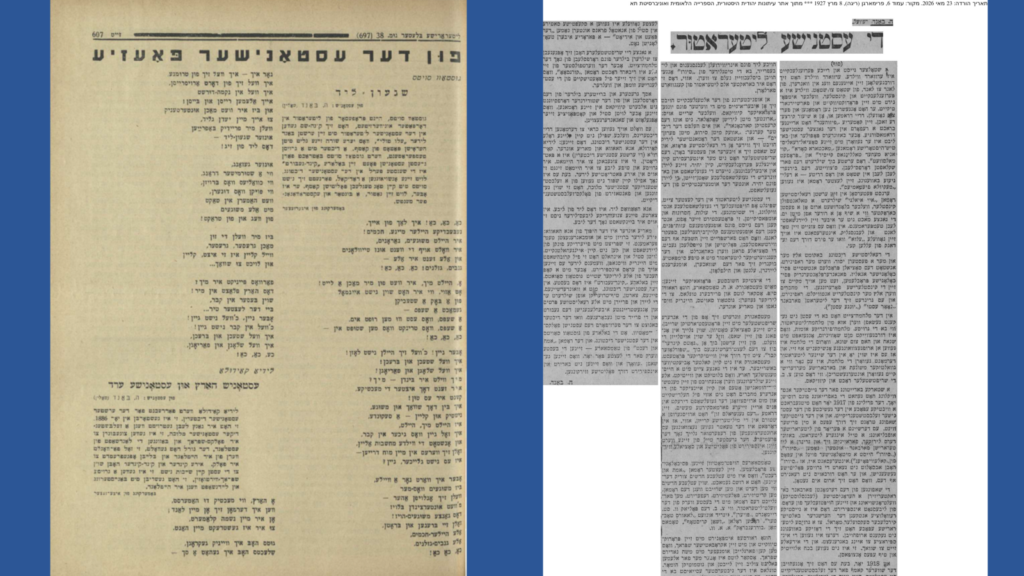
Examples of H. Bant’s writings. On the right, an overview of Estonian literature in the Yiddish-language newspaper Frimorgen published in Riga (1927), and on the left, translations of Gustav Suits's "The Demonic Ones" and Lydia Koidula's "Estonian Soil and Estonian Heart" published in the Warsaw-issued magazine Literarischer Bletter (1937).
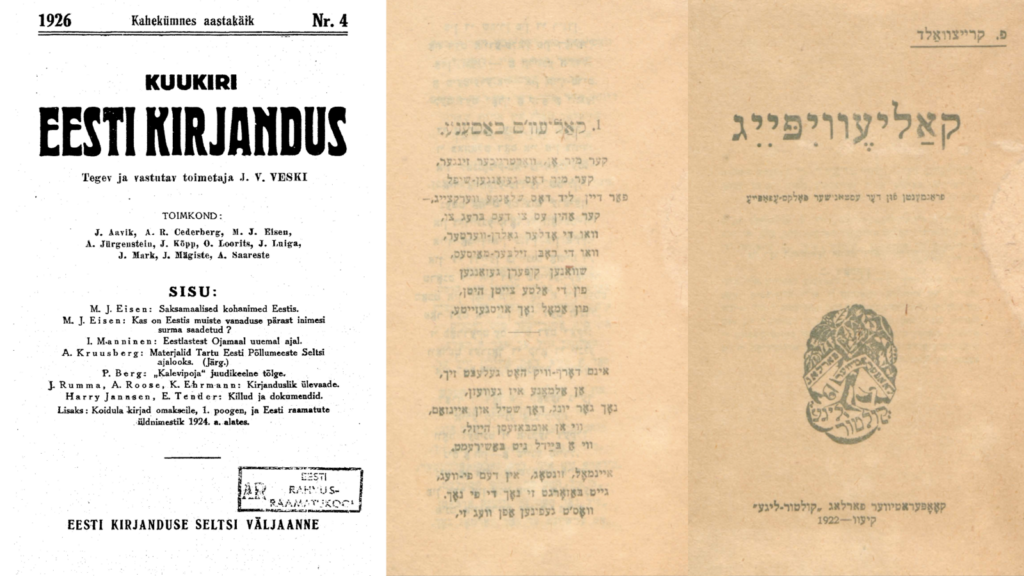
It is also worth noting that Kalevipoeg was translated into Yiddish by B. Raskin as early as 1922 via German (Carl Reinthal), and Paul Ariste reviewed and analyzed this translation in the 1926 monthly journal Eesti Kirjandus (Estonian Literature).
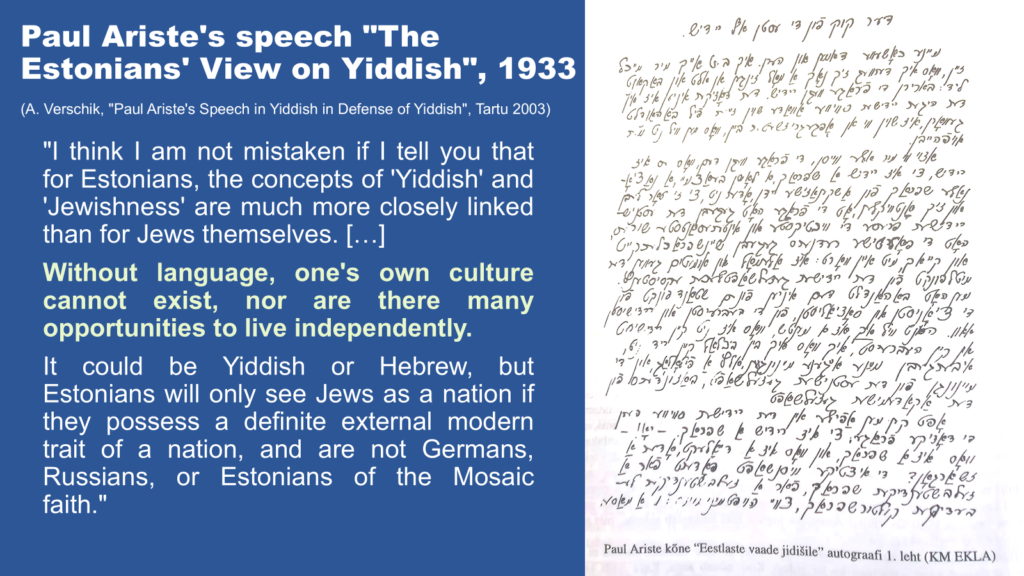
In a Yiddish-language speech delivered for the first time in 1933 at the cultural society "Frajint fun jidiš" in Tartu, and a year later at the Bialik Society in Tallinn, Ariste condemned the linguistic assimilation of Jews, saying: "I believe I am not mistaken when I tell you that for Estonians, the concepts of 'Yiddish' and 'Jewishness' are much more closely linked than they are for the Jews themselves. [...] Without a language, one's own culture cannot exist, nor are there many opportunities to live independently."
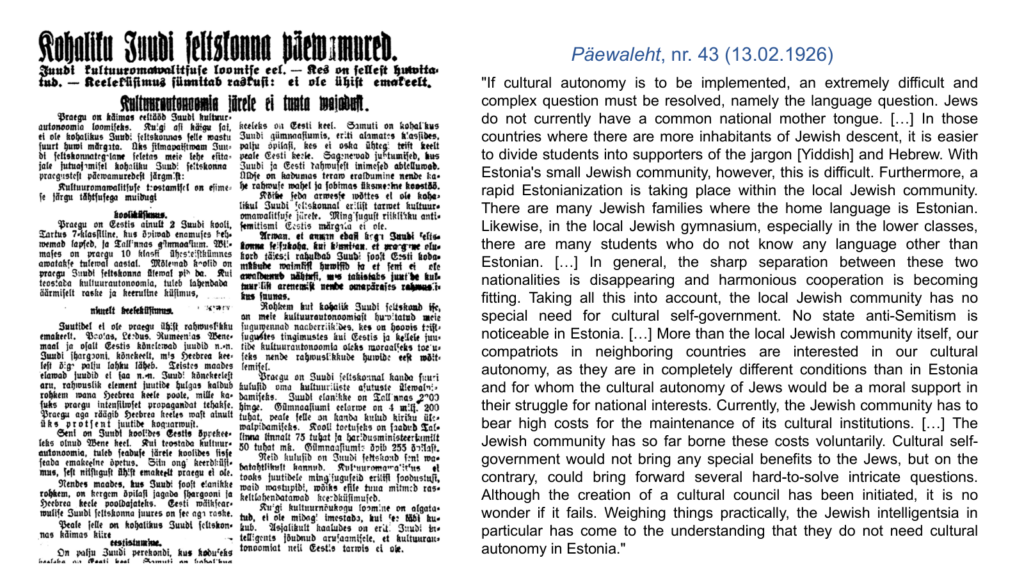
Even before the creation of cultural autonomy, Jewish circles were aware of the importance of the language question, as shown by an article titled "Daily Worries of the Local Jewish Community" published in Päevaleht in February 1926. In it, a prominent Jewish public figure, who is not named, emphasizes that Estonian Jews were rapidly Estonianizing—Estonian was already spoken in many families, and intermarriages with Estonians were becoming more frequent. It is also noted that there was no state antisemitism in Estonia, and the existing situation allowed Jewish culture to develop freely. The author finds that the need for cultural autonomy stemmed more from the expectations of Jews in neighboring countries than from the desire of the local community itself. Furthermore, there were fears that autonomy would bring new complex problems and financial obligations without providing significant benefits.
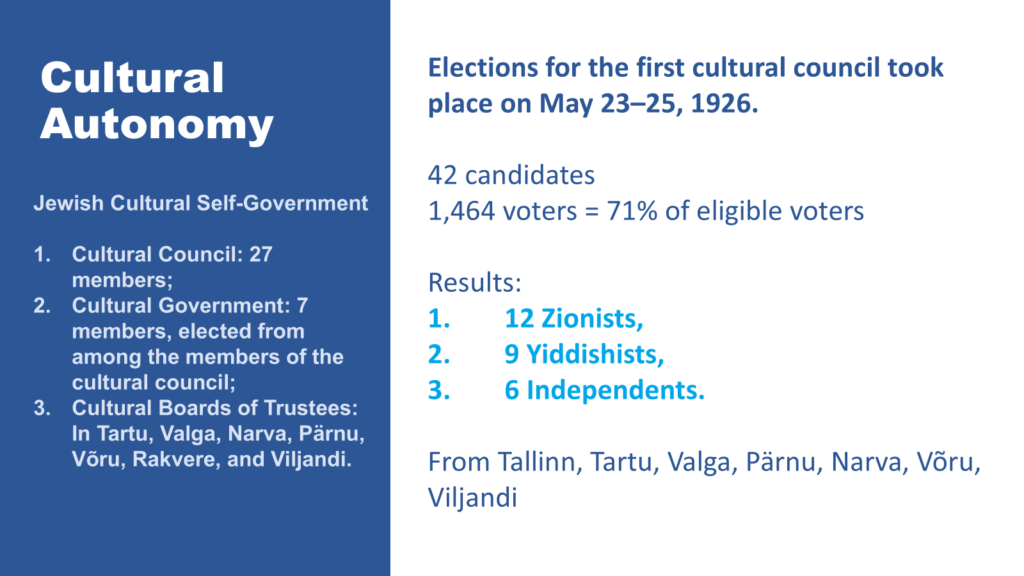
Cultural autonomy was established nonetheless, and it made it possible to develop Jewish education, culture, and society life. At the same time, however, it sharply brought to light an internal community conflict between the proponents of Hebrew and Yiddish. The language question was not specific to Estonia; rather, it joined our Jewish community to a broader, pan-European language dispute that has sometimes even been called a "language war." Namely, at the beginning of the 20th century, the Jewish national movement split into two main directions: Zionists, who favored a Jewish state in Palestine and the revival of the Hebrew language, and Yiddishists/Autonomists, who emphasized Jewish cultural autonomy in the diaspora and the role of Yiddish as the vernacular language. The "language war" between Hebrew and Yiddish reflected two different visions for the future of the Jewish people: whether the future lay in a nation-state and a new "Hebrew person," or in the cultural sustainability of the diaspora. Zionism, in turn, was divided into several currents (political, revisionist, socialist, religious, etc.), and Zionist organizations and youth movements were also active in Estonia.
Representatives of both camps were represented from the very beginning in the Estonian Jewish Cultural Council, which meant heated debates on language and education were built into its DNA.
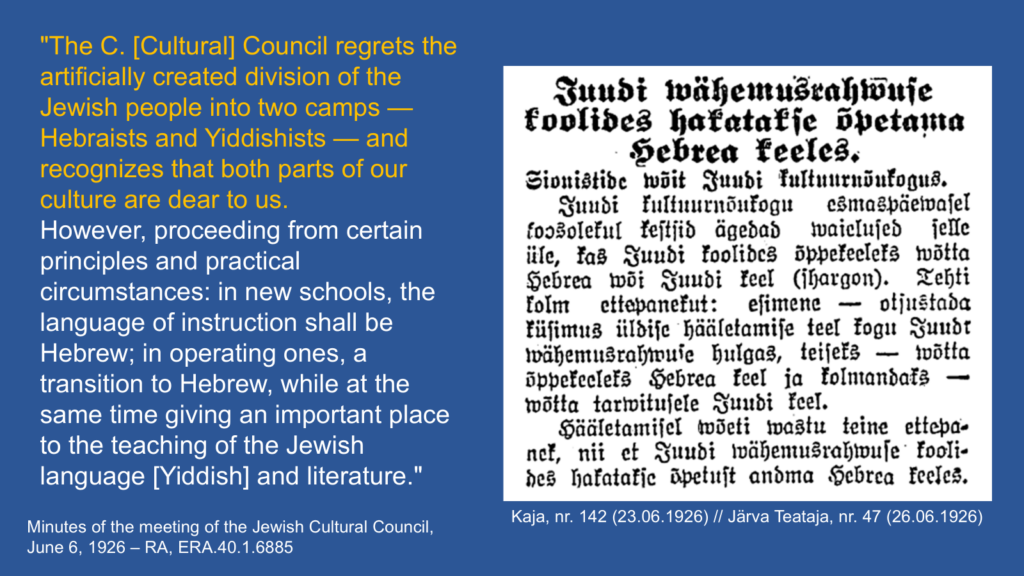
Thus, it is no wonder that at the opening meeting of the first Cultural Council held on June 6, 1926, the question of the language of instruction in Jewish schools sparked the most fiery debates, or as Estonian newspapers reported: "fierce arguments lasted over whether to adopt Hebrew or the Jewish language (jargon) as the language of instruction in Jewish schools. Three proposals were made: first, to decide the issue by a general vote among the entire Jewish national minority; second, to adopt Hebrew as the language of instruction; and third, to bring the Jewish language into use. In the voting, the second proposal was accepted, so that instruction in the schools of the Jewish national minority will begin to be given in Hebrew." The exact wording of the passed proposal, however, read as follows: "The Cultural Council regrets the artificially created division of the Jewish people into two camps—Hebraists and Yiddishists—and recognizes that both parts of our culture are dear to us. However, proceeding from firm principles and practical circumstances: Hebrew shall be the language of instruction in new schools, with a transition to Hebrew in existing ones, while the teaching of the Jewish language and literature shall hold an important place."
The school question remained the sharpest headache for the cultural government until the end: problems were caused by school funding, parents' lack of desire to place their children in Jewish schools, and the language of instruction issue, which threatened to politicize the schools. Essentially, a situation prevailed across the Estonian Jewish educational landscape where, depending on the school and the level of study, the actual language of instruction was either Yiddish, Hebrew, or Russian, and for certain subjects, Estonian: Hebrew did become the language of instruction in the Valga Jewish Primary School established that same year, but in the already operating Jewish schools of Tartu and Tallinn, things were much more complicated.
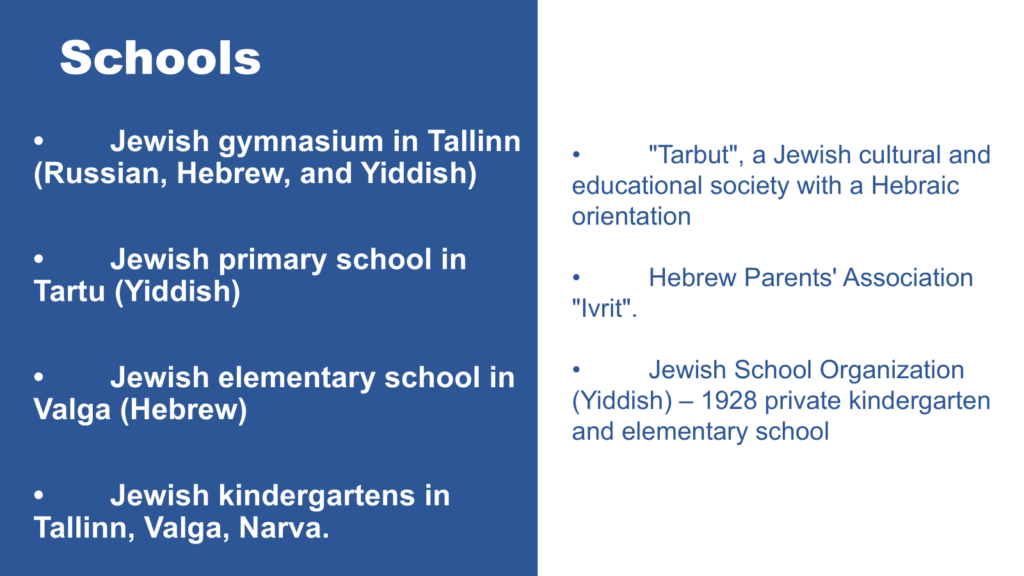
Despite the Cultural Council's 1926 decision, instruction in the Tartu primary and secondary school took place predominantly in Yiddish, whose main competitor seemed to be German instead. Unlike the Tallinn Jews, whose home language alongside Yiddish was largely Russian, many Tartu Jews spoke German at home. Thus, several citizens of Jewish descent in Tartu requested permission from the city school board to enroll their children in the German school. They did not want to send their children to the Jewish school because the children supposedly did not understand the Jewish language.
Each language direction was promoted by its respective organizations.
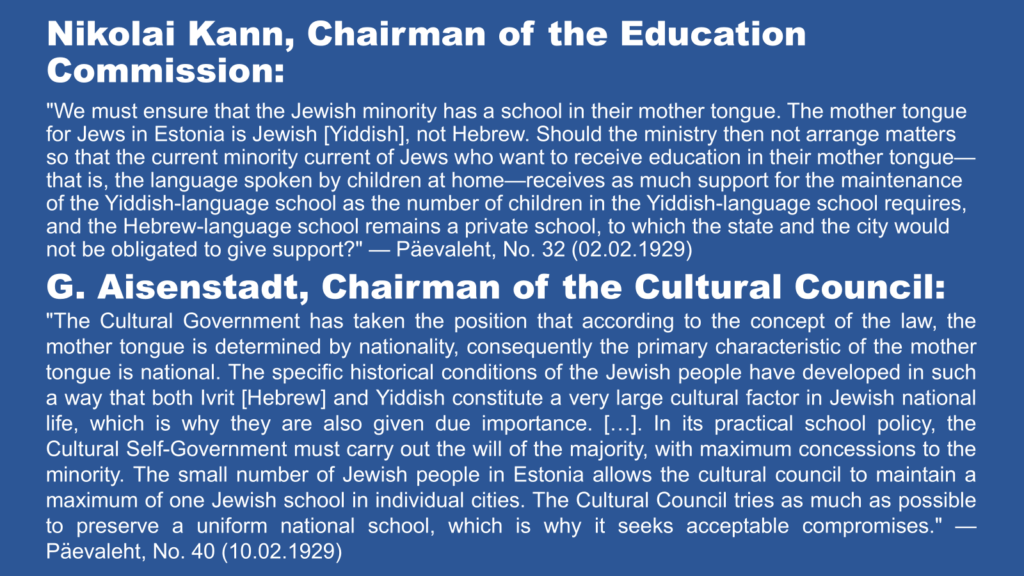
The Ministry of Education officially remained neutral and recognized both as Jewish national languages. In 1929, the chairman of the education commission, Nikolai Kann, wrote openly in Päevaleht in support of the Yiddishists. His argument was simple: just as the mother tongue of Estonians is not the ancient Turanian language but Estonian, so the mother tongue of Jews is not Hebrew but Yiddish. However, the reply from Aisensdat, chairman of the Cultural Council, revealed that the will of the majority was nonetheless Hebrew, and that it was difficult to maintain multiple schools with different languages of instruction in the same city.
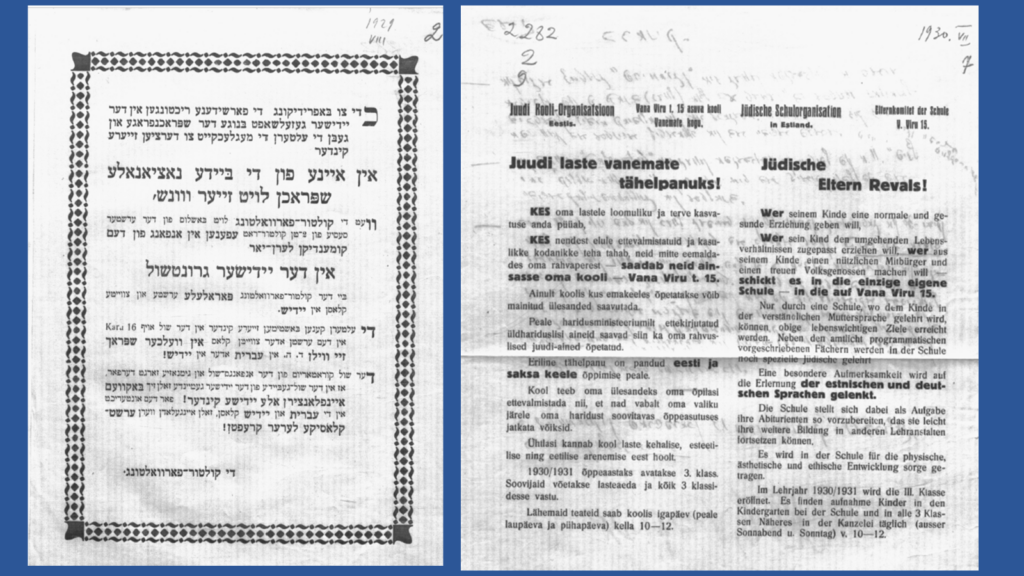
At the same time, an Estonian- and German-language promotional leaflet from the Jewish School Organization from 1930 states "that 'he who strives to give his children a natural and healthy upbringing, he who wants to make them prepared for life and useful citizens, without alienating them from their national family—sends them to the only school of their own (= the Yiddish-language one). Only in a school where teaching is done in the mother tongue can the mentioned tasks be achieved [...] special attention is paid to the learning of the Estonian and German languages.'"
Ultimately, an agreement was reached, and starting from the 1931/1932 school year, the private Jewish school was merged with the Jewish gymnasium, creating parallel classes: Hebrew-language A-classes and Yiddish-language B-classes. Since students had to graduate from school in the language they had started in, Hebrew, Yiddish, and Russian were simultaneously in use as languages of instruction at the Jewish Gymnasium. The students of the parallel classes got along well, but, for example, Liya Kaplan mentions in her memoirs that the Hebrew school students always found an opportunity to show that they were the "true" Jews and the others were just Yiddishists. According to Gurin-Loov, students in the Hebrew-instruction classes were mostly Zionists and belonged to Zionist youth organizations (the socialist-leaning Hashomer Hatzair and the more right-wing Betar), while the school children who studied in Yiddish remained neutral toward the idea of Zionism or were even opposed to it.
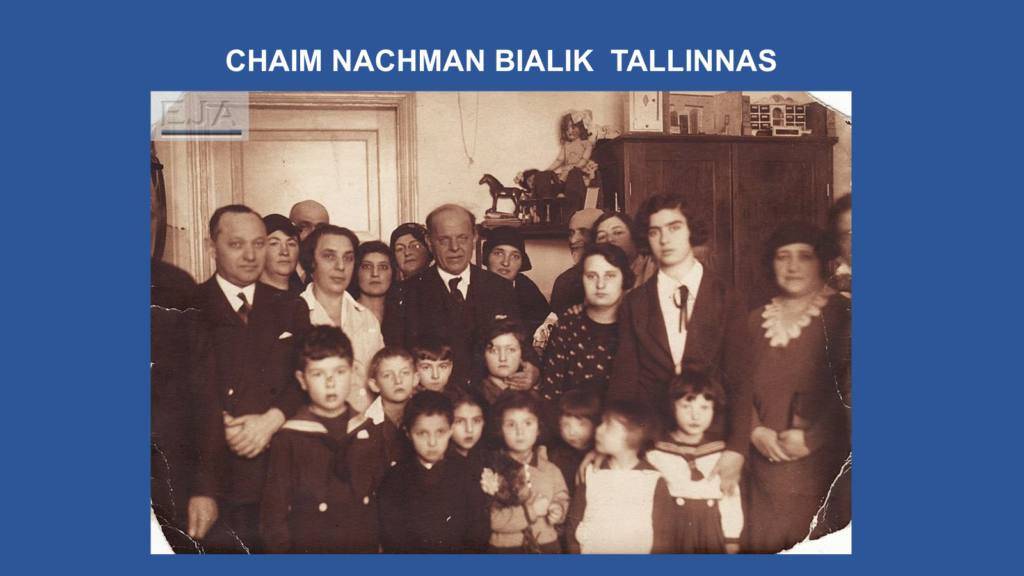
The language dispute culminated in December 1931, when the famous Jewish poet Chaim Nachman Bialik visited Tallinn (pictured in the center).
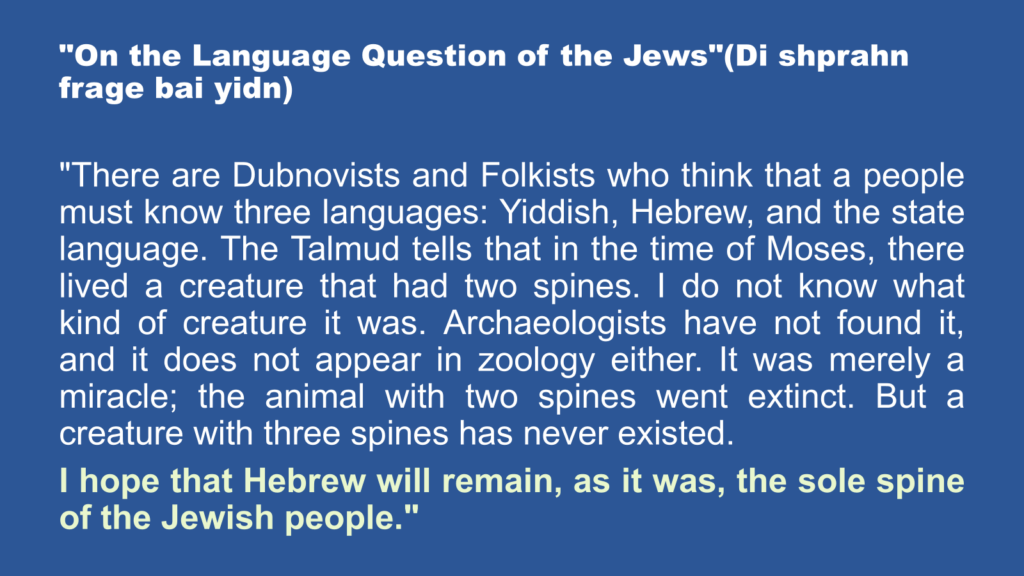
Bialik, known as a Hebraist, delivered a Yiddish-language speech titled "On the Language Question of the Jews" (Di sprahn frage bai jidn) at the Jewish Gymnasium on December 16, 1931. In it, he argued that Hebrew had survived through the ages, while the so-called Jewish vernaculars had faded away; he claimed that Yiddish had fulfilled its role and must die out in the era of Jewish Palestine's existence. Regarding trilingualism, he spoke quite sharply: "There are Dubnovists and Folkists who think that the people must know three languages: Yiddish, Hebrew, and the state language. The Talmud tells that in the time of Moses, there lived an animal that had two spines. I do not know what animal it was. Archaeologists have not found it, and it does not appear in zoology either. It was just a miracle; the animal with two spines went extinct. But there has never been an animal with three spines. I hope that Hebrew remains, as it was, the sole spine of the Jewish people."
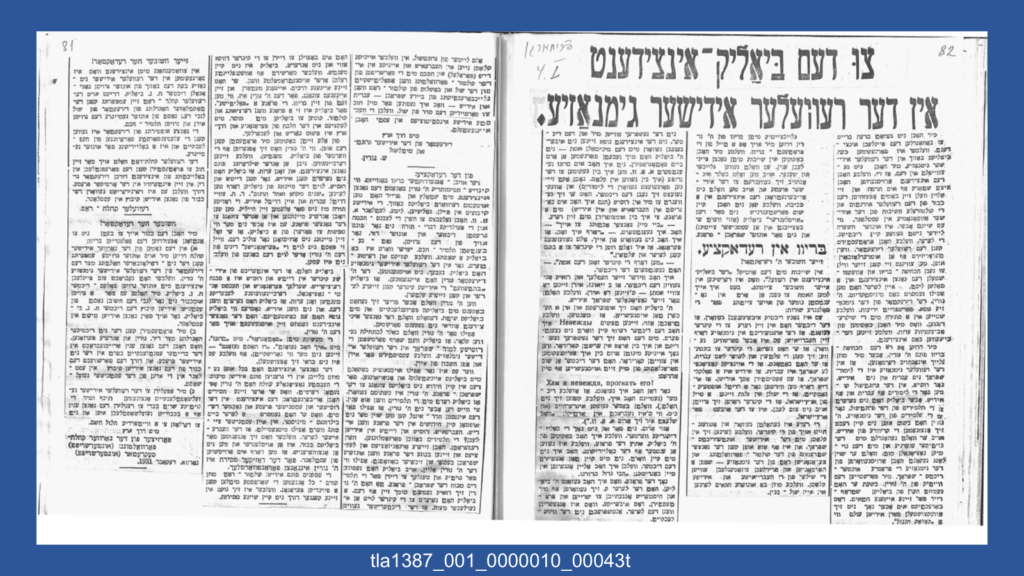
In addition, Bialik opined that there was no place for either German or Russian in a Jewish school (meaning that if they did not study in their mother tongue, they should at least study in the state language, i.e., Estonian) and that students should be resolute about this both at school and at home. This irritated the school's director, S. Gurin, who felt that dragging children into a bitter language war was inappropriate. Bialik, in turn, reportedly replied that children have a right to know the truth. The school director, S. Gurin, maintained a neutral stance and noted that many Jews considered Yiddish to be their national language. This infuriated Bialik. According to newspaper descriptions, he called Gurin stupid, stamped his feet in anger, and their argument continued into the hallway. The real drama, however, followed behind closed doors in the teachers' lounge, where voices grew louder and louder and Bialik reportedly struck Gurin, cancelled his remaining appearances, and left for Riga.
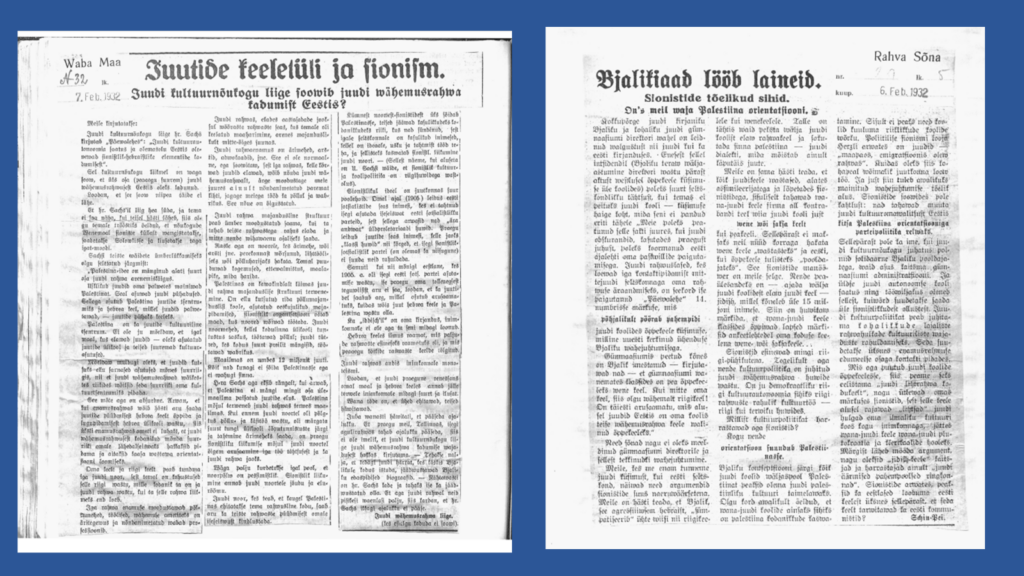
The scandal quickly reached the Estonian press, and the Ministry of Education threatened to close the overly politicized school. As a result of the conflict, the compromise with parallel classes took shape the following year.
Whether in the wake of these events or not, in the elections for the III Cultural Council held in the summer of 1932, the Hebraists won a major victory once again. The feud continued with the same momentum, and the Yiddishists continually accused the Hebraists of using Jewish cultural autonomy as a partisan weapon. The IV Cultural Council, which convened in July 1936, faced the same question: whether Hebrew or Yiddish should be the language of instruction for the gymnasium. The Zionists' wish was to transition the instruction to a single language—Hebrew—in order to mitigate costs and standardize both the coursework and the future generation.
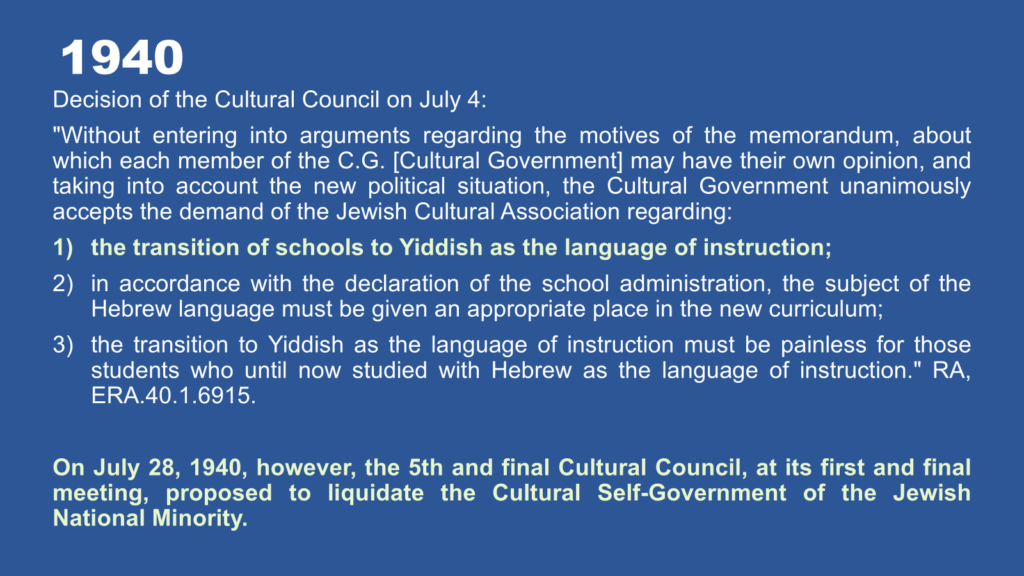
Although as of January 9, 1940, the majority of students in the Tartu and Tallinn Jewish schools studied in Hebrew, on July 2, 1940, the Cultural Council decided to switch the schools to Yiddish as the language of instruction, following demands from teachers of the Yiddish classes. It was found that in connection with the new political situation, instruction in the Tallinn and Tartu schools must take place in Yiddish, while Hebrew as a subject must be guaranteed a corresponding number of hours. In addition, they saw a need to modernize and secularize out-of-school institutions, noting that it was unacceptable for them to remain as "islands of darkness and backwardness" at a time when the entire surrounding environment was being renewed.
Just a few weeks later, on July 28, 1940, the V and final Cultural Council proposed at its first and last meeting to liquidate the cultural self-government of the Jewish national minority. The corresponding declaration stated, among other things, that the Jewish plutocracy in the form of Zionist organizations had oppressed Jewish national culture and thrown the national language, Yiddish, out of the Jewish school, and that it was the will of all Jewish working people to liquidate the hated cultural autonomy—only now was the free development of Jewish culture guaranteed to them. Rahva Hääl, July 29, 1940.
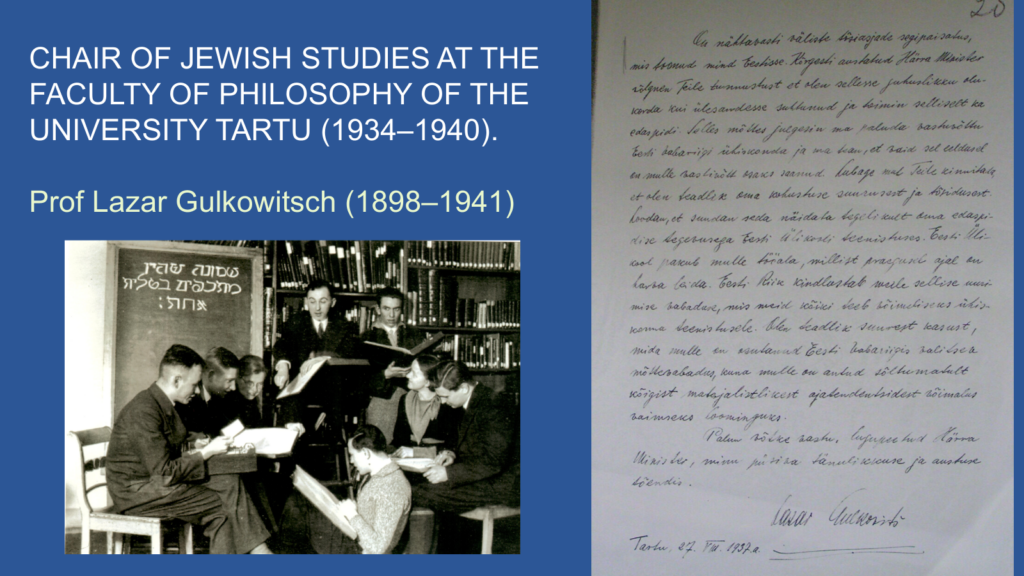
Yet something good did come out of the school issue after all—the desire to ensure a quality education for Jewish children required ensuring a quality teaching staff. With this goal in mind, a chair of Jewish Studies, funded by the Jewish community, was opened in 1934 under the Faculty of Philosophy at the University of Tartu—the only one of its kind in continental Europe, the opening of which was even supported by Albert Einstein.
The fact that this chair, where a total of 21 students studied until its closure in 1940, became something more than a pedagogical seminar is linked to the fact that it came to be led by the Jewish scholar Lazar Gulkowitsch. He was born in 1898 in the territory of modern-day Belarus, studied in Königsberg, and worked at the University of Leipzig until the National Socialists' rise to power forced him and his family to leave Germany. In Tartu, he found the opportunity to freely continue his research. Although he taught in German and Hebrew by special permission, he also mastered Estonian and received Estonian citizenship in 1937 (letters of recommendation for this were provided by Gustav Suits and J. V. Veski, among others).
The scope of Gulkowitsch's research, which was cut short in 1941, is demonstrated by his 24 published studies, manuscripts, and the research program he drafted himself. He viewed himself primarily as a linguist, but functioned simultaneously as a philosopher of language, a historian of religion, and a scholar of Hasidism.
His work was based on a central idea: the concept of spiritual unity, according to which concepts are dynamic and become historical reality through words. Therefore, for Gulkowitsch, history is simultaneously the history of thought, the history of language, and cultural history, where language, thought, and culture form an inseparable whole.
Summary
The story of Estonian Jews in the 1920s and 1930s shows how a small national minority was able to create an exceptionally vibrant and diverse cultural space and a linguistic and cultural bridge. Although the years 1940 and 1941 destroyed this bridge, the life of the Jewish community in re-independent Estonia shows that bridges can be built anew.